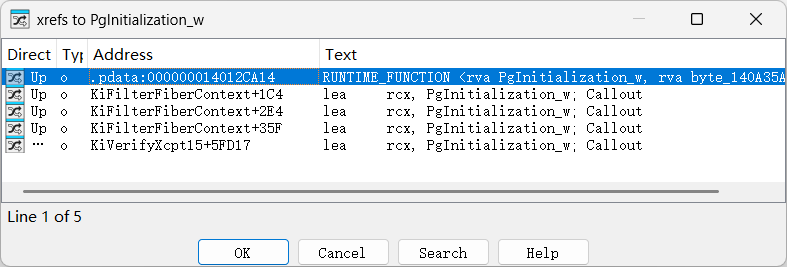
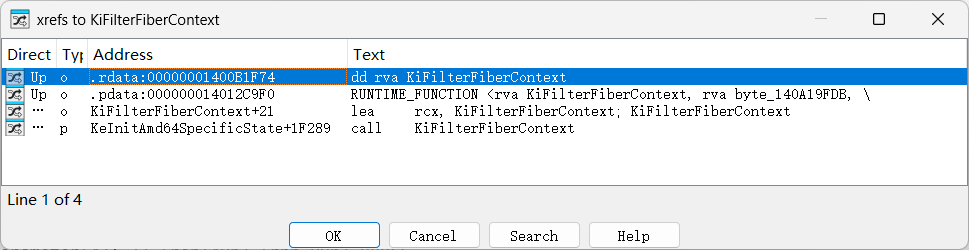
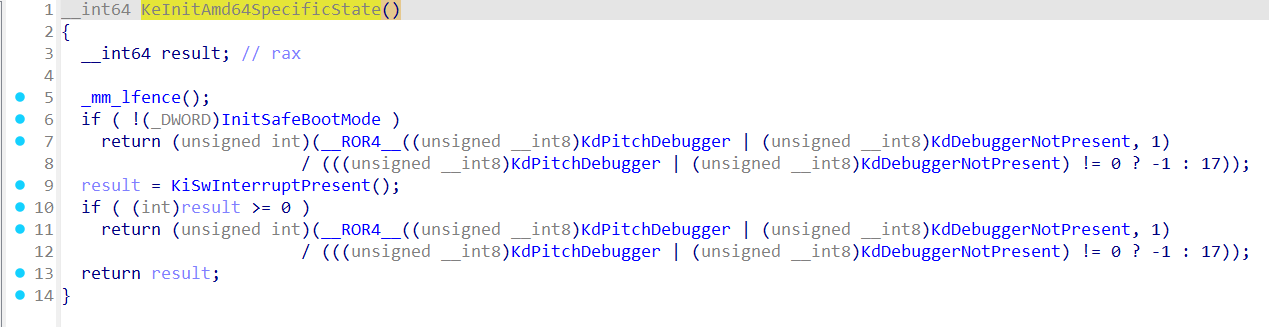
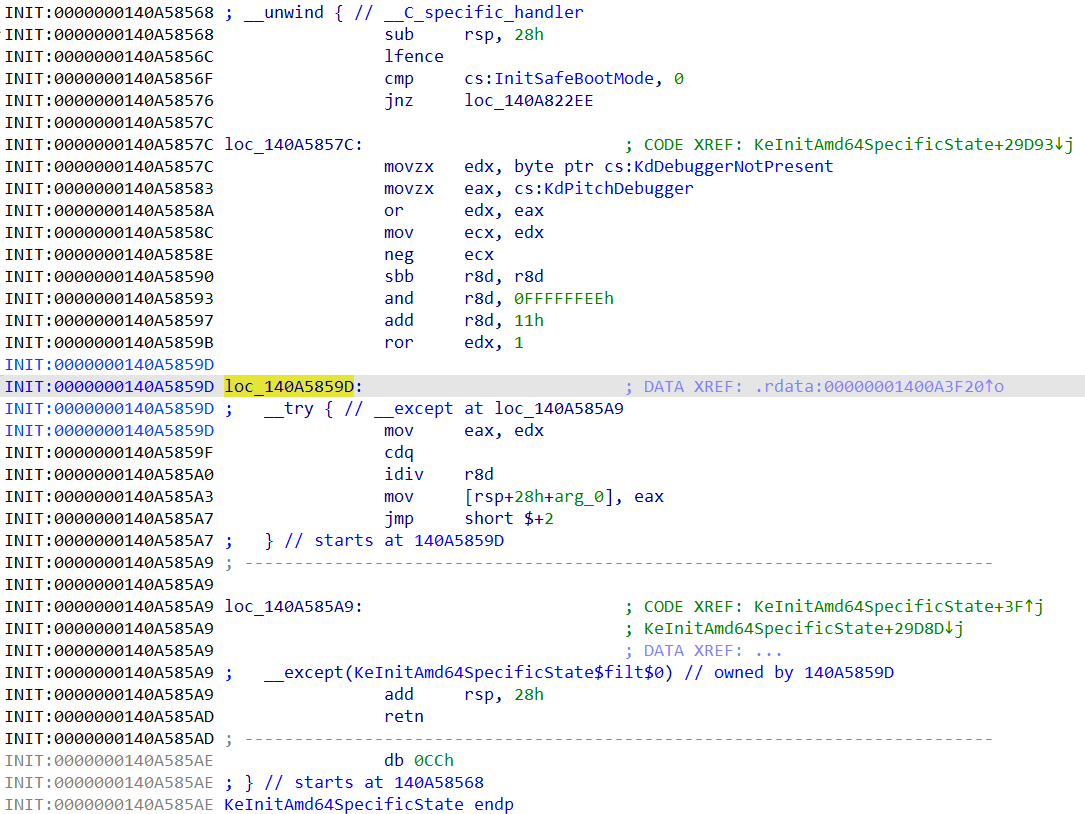
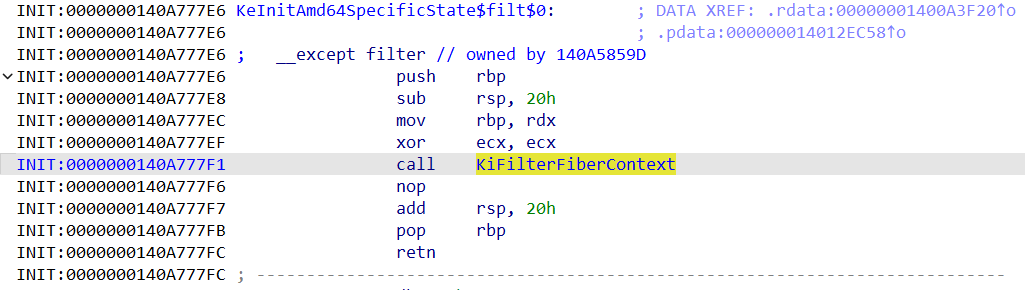
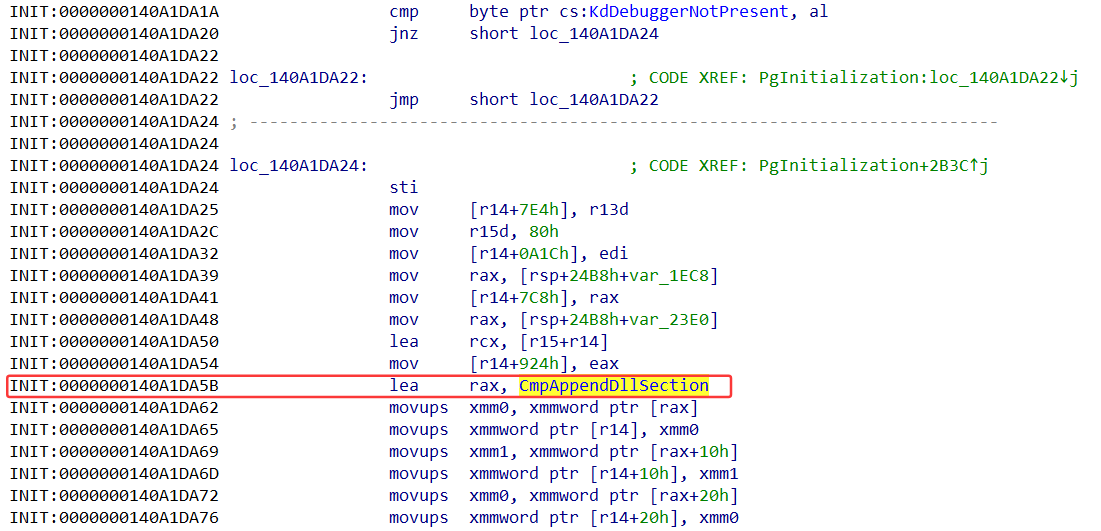
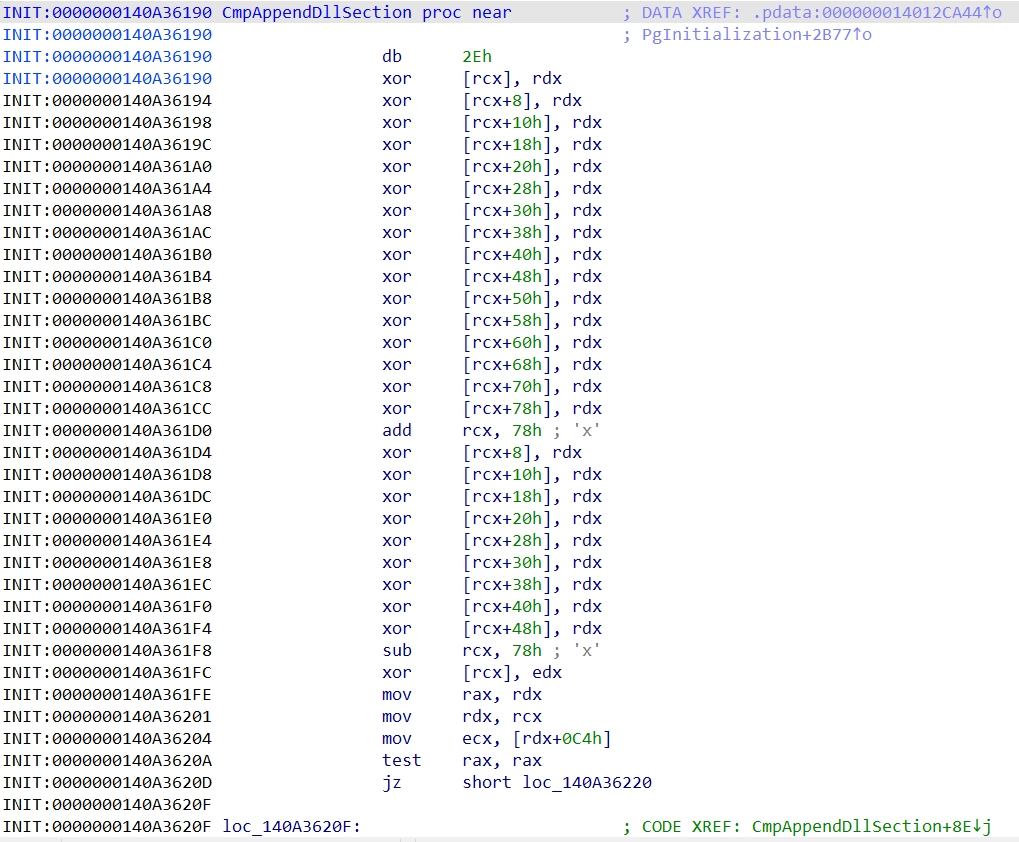
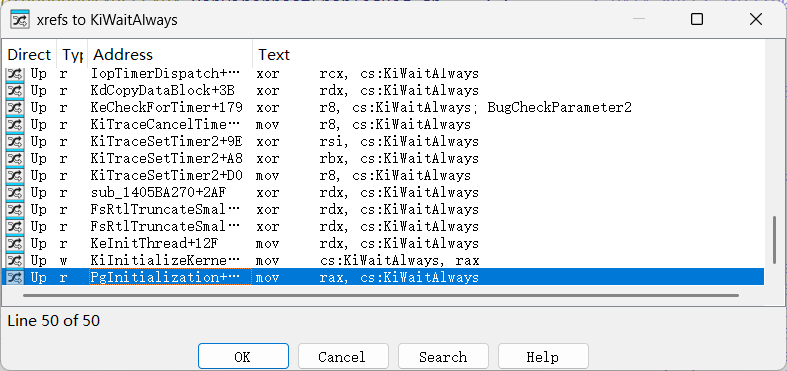
The initialization of PatchGuard is performed mostly by KiFilterFiberContext. This function is called at the beginning of the boot, before any user driver load. KiFilterFiberContext is called in two manners, that are detailed hereafter.[1]
DECLSPEC_NORETURN VOID NTAPI KeBugCheckWithTf(IN ULONG BugCheckCode, IN ULONG_PTR BugCheckParameter1, IN ULONG_PTR BugCheckParameter2, IN ULONG_PTR BugCheckParameter3, IN ULONG_PTR BugCheckParameter4, IN PKTRAP_FRAME TrapFrame) { PKPRCB Prcb = KeGetCurrentPrcb(); CONTEXT Context; ULONG MessageId; CHAR AnsiName[128]; BOOLEAN IsSystem, IsHardError = FALSE, Reboot = FALSE; PCHAR HardErrCaption = NULL, HardErrMessage = NULL; PVOID Pc = NULL, Memory; PVOID DriverBase; PLDR_DATA_TABLE_ENTRY LdrEntry; PULONG_PTR HardErrorParameters; KIRQL OldIrql;
/* Set active bugcheck */ KeBugCheckActive = TRUE; KiBugCheckDriver = NULL;
/* Check if this is power failure simulation */ if (BugCheckCode == POWER_FAILURE_SIMULATE) { /* Call the Callbacks and reboot */ KiDoBugCheckCallbacks(); HalReturnToFirmware(HalRebootRoutine); }
/* Save the IRQL and set hardware trigger */ Prcb->DebuggerSavedIRQL = KeGetCurrentIrql(); InterlockedIncrement((PLONG)&KiHardwareTrigger);
/* Capture the CPU Context */ RtlCaptureContext(&Prcb->ProcessorState.ContextFrame); KiSaveProcessorControlState(&Prcb->ProcessorState); Context = Prcb->ProcessorState.ContextFrame;
/* FIXME: Call the Watchdog if it's registered */
/* Check which bugcode this is */ switch (BugCheckCode) { /* These bug checks already have detailed messages, keep them */ case UNEXPECTED_KERNEL_MODE_TRAP: case DRIVER_CORRUPTED_EXPOOL: case ACPI_BIOS_ERROR: case ACPI_BIOS_FATAL_ERROR: case THREAD_STUCK_IN_DEVICE_DRIVER: case DATA_BUS_ERROR: case FAT_FILE_SYSTEM: case NO_MORE_SYSTEM_PTES: case INACCESSIBLE_BOOT_DEVICE:
/* Keep the same code */ MessageId = BugCheckCode; break;
/* Check if this is a kernel-mode exception */ case KERNEL_MODE_EXCEPTION_NOT_HANDLED: case SYSTEM_THREAD_EXCEPTION_NOT_HANDLED: case KMODE_EXCEPTION_NOT_HANDLED:
/* Use the generic text message */ MessageId = KMODE_EXCEPTION_NOT_HANDLED; break;
/* File-system errors */ case NTFS_FILE_SYSTEM:
/* Use the generic message for FAT */ MessageId = FAT_FILE_SYSTEM; break;
/* Check if this is a coruption of the Mm's Pool */ case DRIVER_CORRUPTED_MMPOOL:
/* Use generic corruption message */ MessageId = DRIVER_CORRUPTED_EXPOOL; break;
/* Check if this is a signature check failure */ case STATUS_SYSTEM_IMAGE_BAD_SIGNATURE:
/* Use the generic corruption message */ MessageId = BUGCODE_PSS_MESSAGE_SIGNATURE; break;
/* All other codes */ default:
/* Use the default bugcheck message */ MessageId = BUGCODE_PSS_MESSAGE; break; }
/* Save bugcheck data */ KiBugCheckData[0] = BugCheckCode; KiBugCheckData[1] = BugCheckParameter1; KiBugCheckData[2] = BugCheckParameter2; KiBugCheckData[3] = BugCheckParameter3; KiBugCheckData[4] = BugCheckParameter4;
/* Now check what bugcheck this is */ switch (BugCheckCode) { /* Invalid access to R/O memory or Unhandled KM Exception */ case KERNEL_MODE_EXCEPTION_NOT_HANDLED: case ATTEMPTED_WRITE_TO_READONLY_MEMORY: case ATTEMPTED_EXECUTE_OF_NOEXECUTE_MEMORY: { /* Check if we have a trap frame */ if (!TrapFrame) { /* Use parameter 3 as a trap frame, if it exists */ if (BugCheckParameter3) TrapFrame = (PVOID)BugCheckParameter3; }
/* Check if we got one now and if we need to get the Program Counter */ if ((TrapFrame) && (BugCheckCode != KERNEL_MODE_EXCEPTION_NOT_HANDLED)) { /* Get the Program Counter */ Pc = (PVOID)KeGetTrapFramePc(TrapFrame); } break; }
/* Wrong IRQL */ case IRQL_NOT_LESS_OR_EQUAL: { /* * The NT kernel has 3 special sections: * MISYSPTE, POOLMI and POOLCODE. The bug check code can * determine in which of these sections this bugcode happened * and provide a more detailed analysis. For now, we don't. */
/* Program Counter is in parameter 4 */ Pc = (PVOID)BugCheckParameter4;
/* Get the driver base */ DriverBase = KiPcToFileHeader(Pc, &LdrEntry, FALSE, &IsSystem); if (IsSystem) { /* * The error happened inside the kernel or HAL. * Get the memory address that was being referenced. */ Memory = (PVOID)BugCheckParameter1;
/* Find to which driver it belongs */ DriverBase = KiPcToFileHeader(Memory, &LdrEntry, TRUE, &IsSystem); if (DriverBase) { /* Get the driver name and update the bug code */ KiBugCheckDriver = &LdrEntry->BaseDllName; KiBugCheckData[0] = DRIVER_PORTION_MUST_BE_NONPAGED; } else { /* Find the driver that unloaded at this address */ KiBugCheckDriver = NULL; // FIXME: ROS can't locate
/* Check if the cause was an unloaded driver */ if (KiBugCheckDriver) { /* Update bug check code */ KiBugCheckData[0] = SYSTEM_SCAN_AT_RAISED_IRQL_CAUGHT_IMPROPER_DRIVER_UNLOAD; } } } else { /* Update the bug check code */ KiBugCheckData[0] = DRIVER_IRQL_NOT_LESS_OR_EQUAL; }
/* Clear Pc so we don't look it up later */ Pc = NULL; break; }
/* Hard error */ case FATAL_UNHANDLED_HARD_ERROR: { /* Copy bug check data from hard error */ HardErrorParameters = (PULONG_PTR)BugCheckParameter2; KiBugCheckData[0] = BugCheckParameter1; KiBugCheckData[1] = HardErrorParameters[0]; KiBugCheckData[2] = HardErrorParameters[1]; KiBugCheckData[3] = HardErrorParameters[2]; KiBugCheckData[4] = HardErrorParameters[3];
/* Remember that this is hard error and set the caption/message */ IsHardError = TRUE; HardErrCaption = (PCHAR)BugCheckParameter3; HardErrMessage = (PCHAR)BugCheckParameter4; break; }
/* Page fault */ case PAGE_FAULT_IN_NONPAGED_AREA: { /* Assume no driver */ DriverBase = NULL;
/* Check if we have a trap frame */ if (!TrapFrame) { /* We don't, use parameter 3 if possible */ if (BugCheckParameter3) TrapFrame = (PVOID)BugCheckParameter3; }
/* Check if we have a frame now */ if (TrapFrame) { /* Get the Program Counter */ Pc = (PVOID)KeGetTrapFramePc(TrapFrame); KiBugCheckData[3] = (ULONG_PTR)Pc;
/* Find out if was in the kernel or drivers */ DriverBase = KiPcToFileHeader(Pc, &LdrEntry, FALSE, &IsSystem); } else { /* Can't blame a driver, assume system */ IsSystem = TRUE; }
/* FIXME: Check for session pool in addition to special pool */
/* Special pool has its own bug check codes */ if (MmIsSpecialPoolAddress((PVOID)BugCheckParameter1)) { if (MmIsSpecialPoolAddressFree((PVOID)BugCheckParameter1)) { KiBugCheckData[0] = IsSystem ? PAGE_FAULT_IN_FREED_SPECIAL_POOL : DRIVER_PAGE_FAULT_IN_FREED_SPECIAL_POOL; } else { KiBugCheckData[0] = IsSystem ? PAGE_FAULT_BEYOND_END_OF_ALLOCATION : DRIVER_PAGE_FAULT_BEYOND_END_OF_ALLOCATION; } } elseif (!DriverBase) { /* Find the driver that unloaded at this address */ KiBugCheckDriver = NULL; // FIXME: ROS can't locate
/* Check if the cause was an unloaded driver */ if (KiBugCheckDriver) { KiBugCheckData[0] = DRIVER_UNLOADED_WITHOUT_CANCELLING_PENDING_OPERATIONS; } } break; }
/* Check if the driver forgot to unlock pages */ case DRIVER_LEFT_LOCKED_PAGES_IN_PROCESS:
/* Program Counter is in parameter 1 */ Pc = (PVOID)BugCheckParameter1; break;
/* Check if the driver consumed too many PTEs */ case DRIVER_USED_EXCESSIVE_PTES:
/* Loader entry is in parameter 1 */ LdrEntry = (PVOID)BugCheckParameter1; KiBugCheckDriver = &LdrEntry->BaseDllName; break;
/* Check if the driver has a stuck thread */ case THREAD_STUCK_IN_DEVICE_DRIVER:
/* The name is in Parameter 3 */ KiBugCheckDriver = (PVOID)BugCheckParameter3; break;
/* Anything else */ default: break; }
/* Do we have a driver name? */ if (KiBugCheckDriver) { /* Convert it to ANSI */ KeBugCheckUnicodeToAnsi(KiBugCheckDriver, AnsiName, sizeof(AnsiName)); } else { /* Do we have a Program Counter? */ if (Pc) { /* Dump image name */ KiDumpParameterImages(AnsiName, (PULONG_PTR)&Pc, 1, KeBugCheckUnicodeToAnsi); } }
/* Check if we need to save the context for KD */ if (!KdPitchDebugger) KdDebuggerDataBlock.SavedContext = (ULONG_PTR)&Context;
/* Check if a debugger is connected */ if ((BugCheckCode != MANUALLY_INITIATED_CRASH) && (KdDebuggerEnabled)) { /* Crash on the debugger console */ DbgPrint("\n*** Fatal System Error: 0x%08lx\n" " (0x%p,0x%p,0x%p,0x%p)\n\n", KiBugCheckData[0], KiBugCheckData[1], KiBugCheckData[2], KiBugCheckData[3], KiBugCheckData[4]);
/* Check if the debugger isn't currently connected */ if (!KdDebuggerNotPresent) { /* Check if we have a driver to blame */ if (KiBugCheckDriver) { /* Dump it */ DbgPrint("Driver at fault: %s.\n", AnsiName); }
/* Check if this was a hard error */ if (IsHardError) { /* Print caption and message */ if (HardErrCaption) DbgPrint(HardErrCaption); if (HardErrMessage) DbgPrint(HardErrMessage); }
/* Break in the debugger */ KiBugCheckDebugBreak(DBG_STATUS_BUGCHECK_FIRST); } }
/* Raise IRQL to HIGH_LEVEL */ _disable(); KeRaiseIrql(HIGH_LEVEL, &OldIrql);
/* Avoid recursion */ if (!InterlockedDecrement((PLONG)&KeBugCheckCount)) { #ifdef CONFIG_SMP /* Set CPU that is bug checking now */ KeBugCheckOwner = Prcb->Number;
/* Freeze the other CPUs */ KxFreezeExecution(); #endif
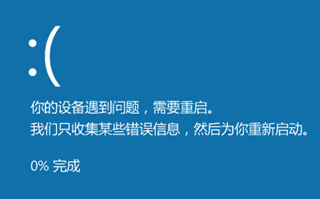
/* Display the BSOD */ KiDisplayBlueScreen(MessageId, IsHardError, HardErrCaption, HardErrMessage, AnsiName);
// TODO/FIXME: Run the registered reason-callbacks from // the KeBugcheckReasonCallbackListHead list with the // KbCallbackReserved1 reason.
/* Check if the debugger is disabled but we can enable it */ if (!(KdDebuggerEnabled) && !(KdPitchDebugger)) { /* Enable it */ KdEnableDebuggerWithLock(FALSE); } else { /* Otherwise, print the last line */ InbvDisplayString("\r\n"); }
/* Save the context */ Prcb->ProcessorState.ContextFrame = Context;
/* FIXME: Support Triage Dump */
/* FIXME: Write the crash dump */ // TODO: The crash-dump helper must set the Reboot variable. Reboot = !!IopAutoReboot; } else { /* Increase recursion count */ KeBugCheckOwnerRecursionCount++; if (KeBugCheckOwnerRecursionCount == 2) { /* Break in the debugger */ KiBugCheckDebugBreak(DBG_STATUS_BUGCHECK_SECOND); } elseif (KeBugCheckOwnerRecursionCount > 2) { /* Halt execution */ while (TRUE); } }
/* Call the Callbacks */ KiDoBugCheckCallbacks();
/* FIXME: Call Watchdog if enabled */
/* Check if we have to reboot */ if (Reboot) { /* Unload symbols */ DbgUnLoadImageSymbols(NULL, (PVOID)MAXULONG_PTR, 0); HalReturnToFirmware(HalRebootRoutine); }
/* Attempt to break in the debugger (otherwise halt CPU) */ KiBugCheckDebugBreak(DBG_STATUS_BUGCHECK_SECOND);
/* Shouldn't get here */ ASSERT(FALSE); while (TRUE); }